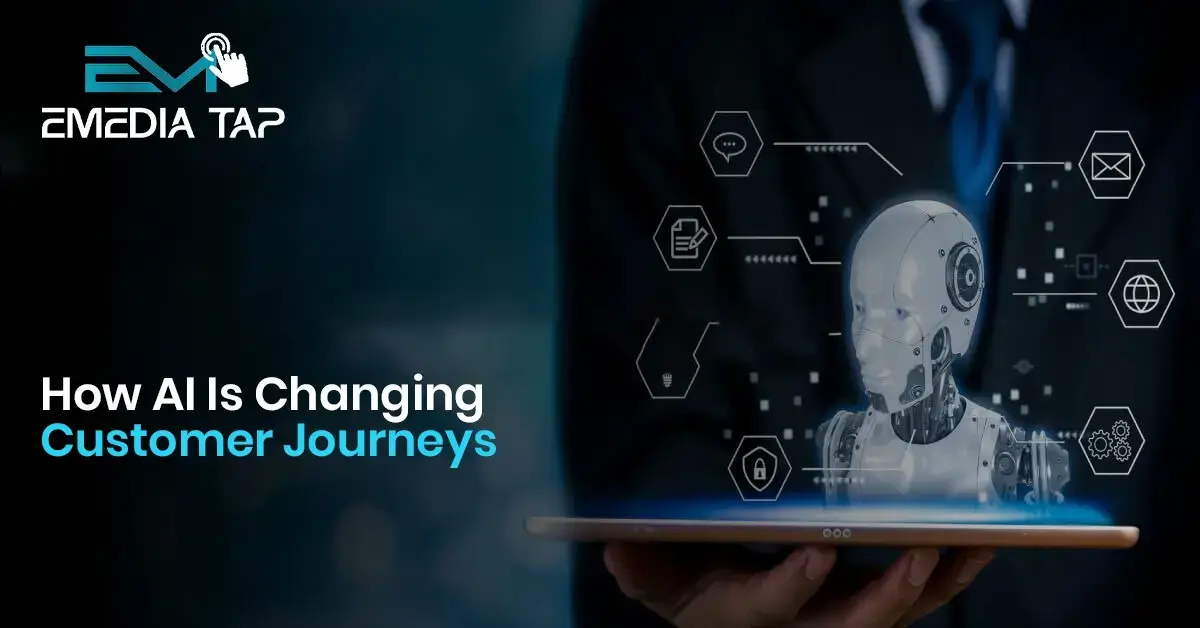
The customer journey is no longer a straight line. People discover brands through Google, social media, online reviews, websites, and increasingly, AI tools. They may ask an AI assistant for recommendations, compare options, visit a website, and make a purchase—all within a much more connected digital experience.
AI is changing customer journeys by making them faster, more personalized, and more responsive. For businesses, understanding this shift is essential to staying competitive and meeting customers where they are.
What Is the Modern Customer Journey?
The customer journey includes every interaction a person has with a business, from first discovering a brand to becoming a loyal customer.
Traditionally, customers moved through awareness, consideration, purchase, and retention. Today, the journey is less predictable. A customer may discover a business through social media, search for reviews, ask an AI tool for advice, and return to the website several times before making a decision.
AI helps businesses understand these interactions and create smoother experiences across each stage.
AI Makes Customer Experiences More Personal
Personalization is one of AI’s biggest advantages.
AI can analyze browsing behavior, previous purchases, searches, and customer interactions to identify interests and preferences. Businesses can then use these insights to provide more relevant recommendations, content, advertisements, and offers.
For example, an online store can recommend products based on previous activity, while a restaurant can promote dishes based on customer interests.
AI Is Changing How Customers Search
Search is becoming increasingly conversational. Instead of typing short keywords, customers can ask detailed questions and expect direct answers from search engines and AI assistants.
This means businesses need more than traditional keyword optimization. They also need useful, clear, and trustworthy content that answers real customer questions.
Strategies such as SEO, Answer Engine Optimization (AEO), and Generative Engine Optimization (GEO) can help businesses remain visible as search behavior continues to evolve.
AI Improves Customer Support
Customers expect quick responses. AI-powered chatbots can provide instant answers to frequently asked questions, product information, appointment details, order updates, and basic troubleshooting.
This can reduce waiting times and improve the overall customer experience.
However, AI does not have to replace human support. Instead, it can handle repetitive questions while employees focus on complex problems that require judgment and empathy.
AI Helps Businesses Predict Customer Needs
AI can analyze customer behavior to identify patterns and predict what customers may want next.
For example, if someone repeatedly visits a service page without making contact, AI can help identify that person as a potential lead. A business can then provide useful information or a relevant follow-up.
This allows companies to move from simply reacting to customers toward anticipating their needs.
AI Makes Marketing More Efficient
Marketing involves many repetitive tasks, including audience segmentation, content planning, campaign analysis, and customer follow-ups.
AI can assist with these processes by analyzing large amounts of information quickly and identifying useful patterns.
It can help marketers understand which audiences are responding, which content performs best, and where improvements may be needed.
The result is more efficient marketing and better opportunities to deliver relevant messages.
AI Connects Different Customer Touchpoints
Customers interact with businesses across multiple channels, including websites, social media, search engines, email, and messaging platforms.
AI can help businesses understand these interactions as part of one customer journey rather than treating every channel separately.
A more connected experience means customers can receive consistent information and spend less time repeating their needs.
Human Connection Still Matters
Despite the rapid growth of AI, human interaction remains important.
Customers want businesses they can trust. They value empathy, creativity, transparency, and genuine communication—qualities technology cannot fully replace.
The strongest strategy is therefore not AI versus humans, but AI working alongside people.
AI can provide speed, automation, and data analysis, while human teams provide creativity, judgment, and meaningful relationships.
How Businesses Can Adapt
Businesses preparing for AI-driven customer journeys should focus on a few key areas:
- Create helpful, customer-focused content.
- Optimize websites for search and AI discovery.
- Use customer data responsibly.
- Automate repetitive tasks where appropriate.
- Improve website speed and user experience.
- Provide fast AI-assisted customer support.
- Maintain human support for complex situations.
- Measure customer behavior and continuously improve.
Frequently Asked Questions (FAQs)
1.How is AI changing customer journeys?
AI makes customer journeys more personalized, automated, and data-driven. It helps businesses understand customer behavior, provide relevant recommendations, and improve communication.
2.Can AI improve customer service?
Yes. AI chatbots can answer common questions instantly and assist customers around the clock, while human employees handle more complicated issues.
3.Does AI replace human interaction?
No. AI can automate repetitive tasks, but human creativity, empathy, and decision-making remain essential for building customer trust.
4.How does AI affect SEO?
AI is changing how people search and discover businesses. Companies increasingly need helpful, authoritative content optimized for traditional search as well as AI-powered search experiences.
5.How can businesses use AI effectively?
Businesses should begin with customer needs and use AI where it improves personalization, efficiency, support, and decision-making rather than adopting technology simply for the sake of it.
The Future of Customer Journeys
AI is transforming how customers discover, evaluate, and interact with businesses. From personalized recommendations and AI-powered search to automated support and predictive insights, the technology is creating new opportunities at every stage of the customer journey.
For businesses, the goal should not be to automate everything. It should be to remove friction, provide better experiences, and build stronger customer relationships.
At E Media Tap, businesses can combine SEO, content marketing, social media, website development,and AI-focused strategies to adapt to this evolving digital landscape. The customer journey is changing—and businesses that adapt intelligently can turn more digital interactions into lasting customers.